Free Practice Workbook
Excel Pivot Tables have a lot of useful calculations under the SHOW VALUES AS option and one that can help you a lot is the Excel Pivot Table Percentage of Row Total. This option will immediately calculate the percentages for you from a table filled with numbers such as sales data, expenses, attendance, or anything that can be quantified.
Key Takeaways:
- % of Row Total shows each value as a percentage of its row total.
- Add the same value field twice to display both values and percentages.
- Use Show Values As to calculate row percentages automatically.
- Apply Percentage number formatting for easier reading.
- Each row in the Pivot Table totals 100%
Table of Contents
How to Show The Percent of Row Total
STEP 1: Select any cell in the Data Table
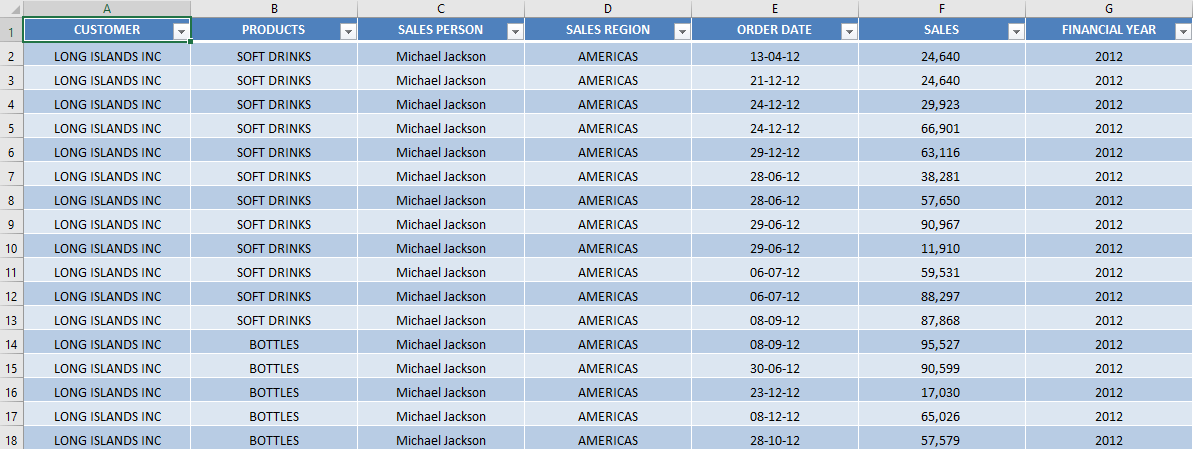
STEP 2: Go to Insert > PivotTable.

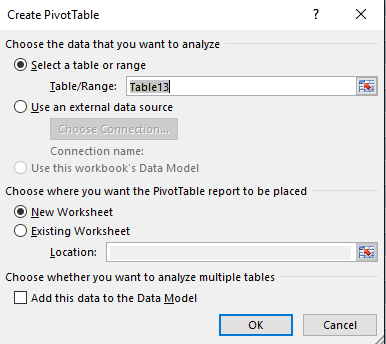
STEP 3: In the Create PivotTable dialog box, select table range and New Worksheet and then Click OK.
STEP 4: In the ROWS section put in the Sales Person field, in the COLUMNS put in the Financial Year field and in the VALUES area you need to put in the Sales field twice, I explain why below:
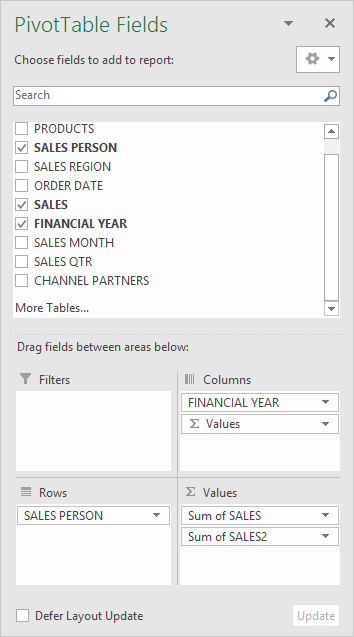
A Pivot Table will be created and looks like this:

STEP 5: Click the second Sales field’s (Sum of SALES2) drop-down and choose Value Field Settings
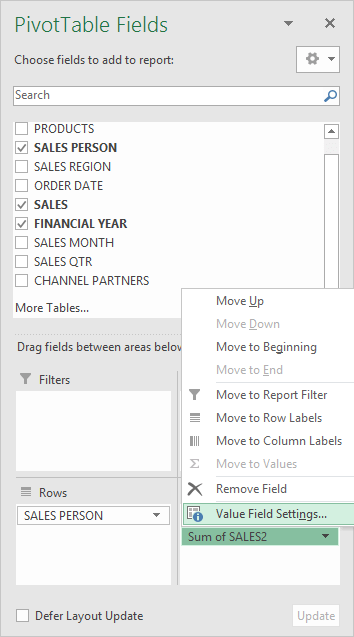
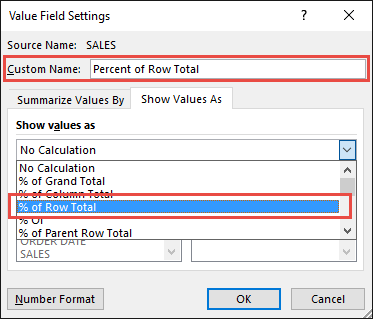
STEP 6: Select the Show Values As tab and from the drop-down choose % of Row Total.
Also, change the Custom Name to Percent of Row Total to make it more presentable. Click OK.
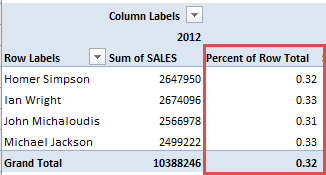
STEP 7: Notice that the Percent of Row Total data is in a decimal format that is hard to read:
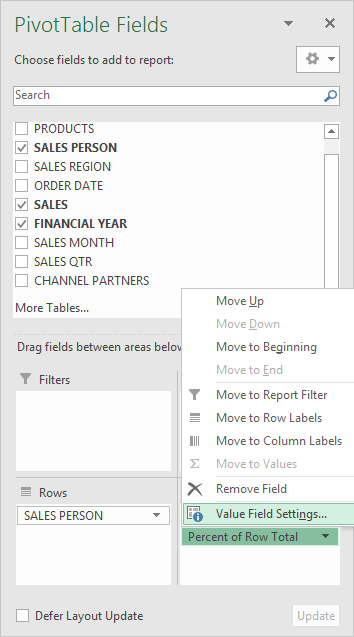
To format the Percent of Row Total column, click the second Sales field’s (Percent of Row Total) drop-down and choose Value Field Settings.
The goal here is for us to transform numbers from a decimal format (i.e., 0.23), into a percentage format that is more readable (i.e., 23%).
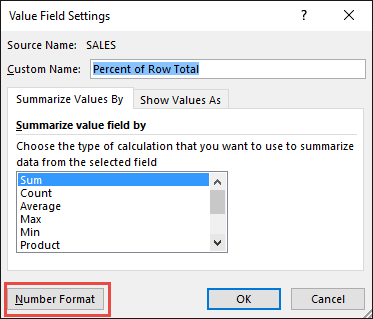
STEP 8: Click the Number Format button.
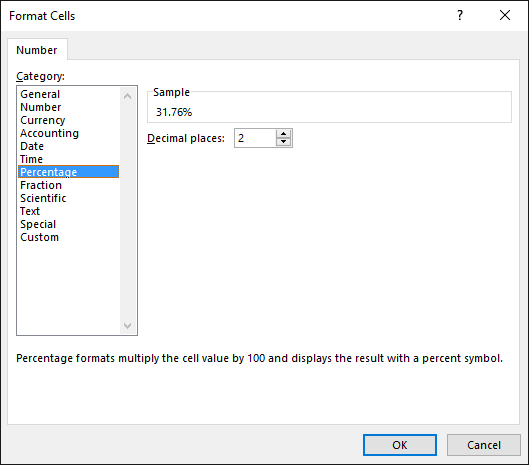
STEP 9: Inside the Format Cells dialog box, make your formatting changes within here and press OK twice.
In this example, we used the Percentage category to make our Percent of Row Total numbers become more readable.
You now have your Pivot Table, showing the Percent of Row Total for the sales data of years 2012, 2013, and 2014.
All of the sales numbers are now represented as a Percentage of each row (Years 2012, 2013, and 2014), which you can see on each row is represented as 100% in totality.
Particularly, the yellow-highlighted ones would total to 100% for the first row:

Tips & Tricks
- The calculation is based on the total of each row, not the entire Pivot Table.
- If you filter the Pivot Table, the percentages are recalculated based on the visible data.
- You can keep the original values by adding the same field to the Values area a second time.
- Format the results as Percentage to make them easier to read.
- Use % of Row Total only when you want to compare values within the same row. If you need a different comparison, consider % of Column Total or % of Grand Total instead.
FAQs
1. What does % of Row Total mean in a Pivot Table?
It shows each value as a percentage of the total for its row, making it easier to compare values within the same row.
2. How to show percentages and values together?
Add the same field to the Values area twice. Keep one as the original value and set the other to % of Row Total.
3. Why do my percentages appear as decimals?
The values use the default number format. Apply the Percentage number format to display them correctly.
4. When to use % of Row Total?
You can use % of Row Total when you want to compare how much each value contributes to the total of its row.
5. Will each row always add up to 100%?
Yes. Since each value is calculated as a percentage of its row total, every row adds up to 100%.


Bryan
Bryan Hong is an IT Software Developer for more than 10 years and has the following certifications: Microsoft Certified Professional Developer (MCPD): Web Developer, Microsoft Certified Technology Specialist (MCTS): Windows Applications, Microsoft Certified Systems Engineer (MCSE) and Microsoft Certified Systems Administrator (MCSA).
He is also an Amazon #1 bestselling author of 4 Microsoft Excel books and a teacher of Microsoft Excel & Office at the MyExecelOnline Academy Online Course.

 30 Days - Full Access