Free Practice Workbook
Adding numbers in a column in Microsoft Excel is one of the most common tasks. It is useful when working with data like expenses, sales, or totals. In this article, you will learn various methods to sum a column in Excel.
Key Takeaways:
- You can sum multiple ranges or columns in one formula easily.
- The SUM function ignores text and only adds numbers.
- It supports up to 255 arguments in a single formula.
- AutoSum is a quick and easy way to sum columns in Excel.
- The AGGREGATE and SUBTOTAL functions help manage errors and sum only visible cells.
Table of Contents
Getting Started with Basic SUM
How to Sum a Column in Excel
The SUM formula is a simple formal of adding up numbers in Excel. It will return the total of the values in a range of cells. Here’s how it looks:
=SUM(number1, [number2], [number3], ...)
In this formula, number1, number2, number3, etc., can be either individual numbers, cell references, or range references. When you use a range reference, Excel sums all the numbers within that range.
For example, =SUM(A1:A10) will give you the total of all numbers from cell A1 down to A10.
The SUM function only works with numbers. If there are any text entries in your range, they will be ignored. It has the ability to handle up to 255 individual arguments, which means you can sum numbers across multiple ranges and standalone cells within the same formula.
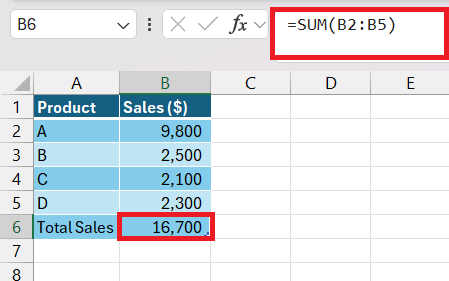
For a quick sum, you can use this formula to display the total of the cells B2 through B5.
Understanding Cell References
There are three types of cell references: relative, absolute, and mixed.
When you copy a formula with a relative reference to another cell, the cell reference changes.
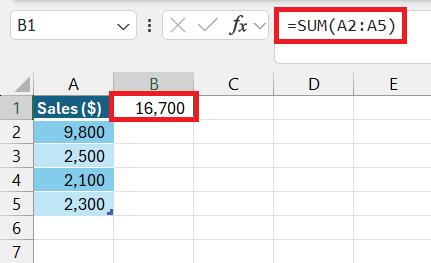
When you copy the formula in B1 to B2, the formula automatically adjusts to =SUM(A2:A6).
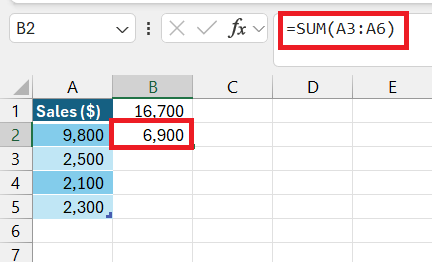
On the other hand, absolute references remain constant no matter where they are copied. If you copy this formula from B1 to B2, it will remain =SUM($A$2:$A$5) in B2.
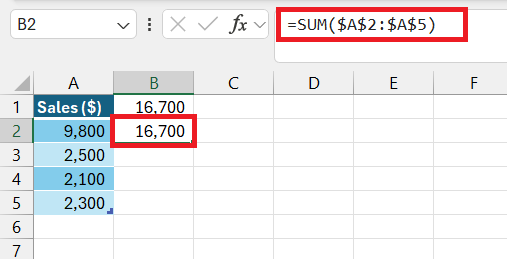
Mixed references are a combination of relative and absolute references. In the mixed reference formula, either the row or the column remains fixed.
=SUM(A$2:A$5)
This formula will keep the row constant but allows the column to adjust when the formula is copied across columns.
Advancing SUM Variations
AutoSum
AutoSum in Microsoft Excel is a quick tool that automatically adds numbers for you.
STEP 1: Select the cell where you want the sum value to appear.
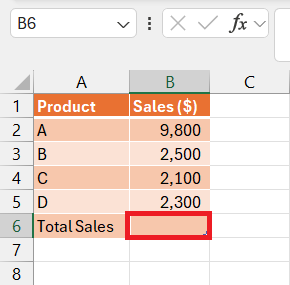
STEP 2: Go to the ‘Home’ tab.
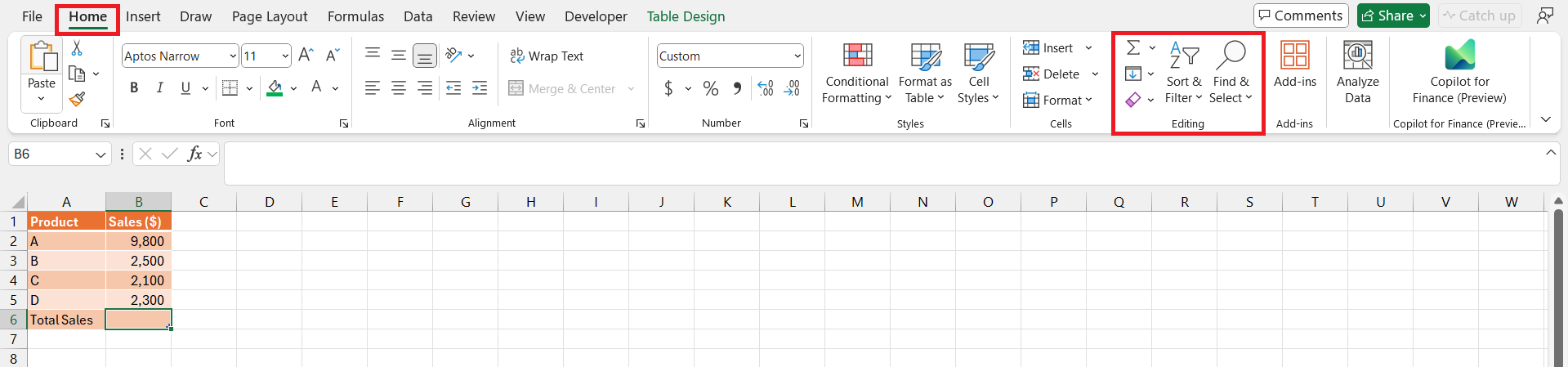
STEP 3: Under the editing group, press the AutoSum button.
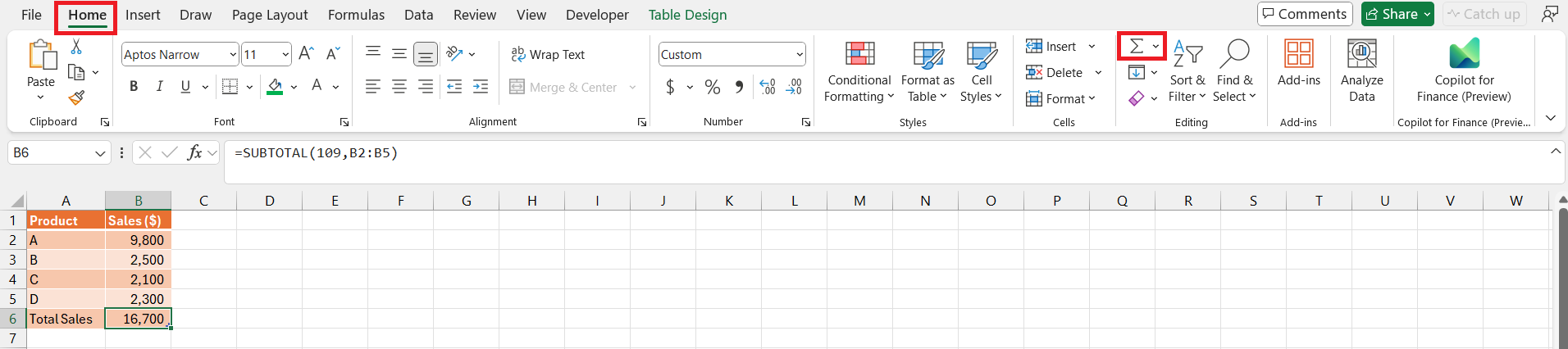
You can also press Alt + = to quickly get an AutoSum.
FAQs
How to sum an entire column in Excel?
You can use the SUM function with the full column as a reference,
=SUM(A:A)
This formula will automatically update the total value when you add more figures in column A.
What is the formula for total sum in Excel?
The SUM function can be used to get the total summation of values.
=SUM(A1:A10)
This will add up all the numbers from cell A1 to A10.
How to Sum Multiple Columns at Once?
To sum multiple columns at once in Excel, you can use the SUM function across several ranges.
=SUM(A1:A10, B1:B10, C1:C10)
It would sum up cells in columns A, B, and C from the 1st to the 10th row.
What If My Column Contains Errors?
If your column contains errors or blank cells, you can use the AGGREGATE function to calculate a sum.
=AGGREGATE(9, 6, range)
The ‘9’ indicates a sum, and the ‘6’ tells Excel to ignore errors.
How to sum just visible cells?
To sum just the visible cells after filtering in Excel, you use the SUBTOTAL function.
=SUBTOTAL(109, range)
The ‘109’ function code tells Excel to add up only visible cells within the range, ignoring any that have been hidden.

John Michaloudis is a former accountant and finance analyst at General Electric, a Microsoft MVP since 2020, an Amazon #1 bestselling author of 4 Microsoft Excel books and teacher of Microsoft Excel & Office over at his flagship MyExcelOnline Academy Online Course.

 30 Days - Full Access